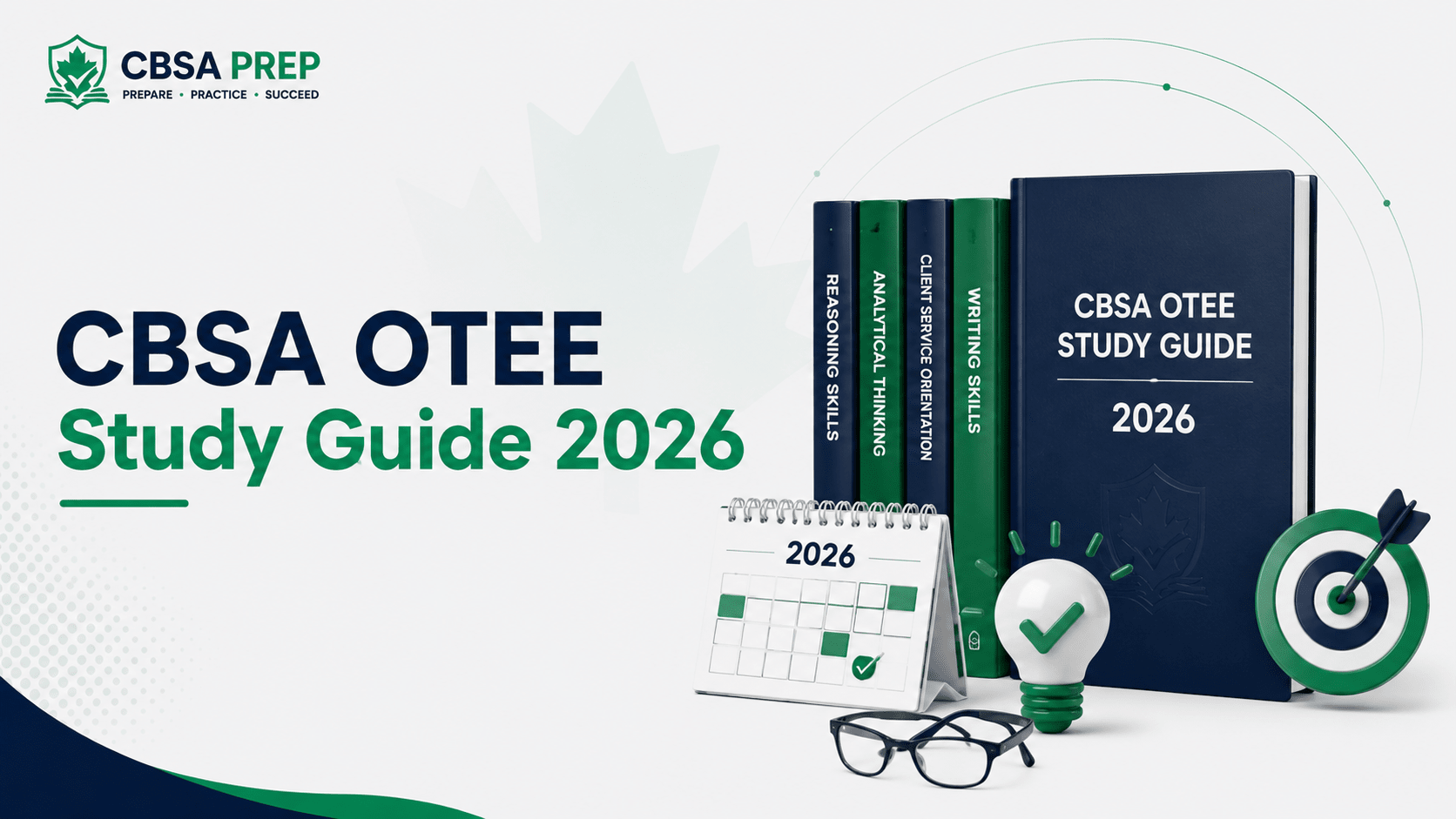
Receiving your OTEE invitation can make the exam suddenly feel urgent. You have one week to complete the test, but once you begin, you must finish all 117 multiple-choice questions within 135 minutes. The smartest response is not to fill every available day with random questions. It is to use the time before your chosen test session deliberately.
This CBSA OTEE study guide gives you a practical preparation sequence: understand the exam, establish your baseline, identify why you are losing marks, strengthen the right skills and complete several properly reviewed timed simulations.
Start with the Free CBSA OTEE practice test before assuming which competency is strongest or weakest. You can also use CBSA PREP as a central hub for the full practice options and competency guides referenced throughout this article.
CBSA OTEE Preparation: The Essential Facts
The Officer Trainee Entrance Exam is an online assessment used during the early stages of the CBSA border services officer selection process.
According to the official CBSA entrance exam page:
- The exam contains 117 multiple-choice questions.
- You have 135 minutes once the exam begins.
- You have one week in which to complete it.
- Once started, the exam must be finished.
- The questions are hypothetical.
- Prior knowledge of the CBSA is not required.
- The exam assesses four separate competencies.
Those competencies are:
- Reasoning Skills
- Analytical Thinking
- Client Service Orientation
- Writing Skills
CBSA public information also states that candidates require 60% correct in each competency to be successful. A strong result in one area therefore should not be treated as protection against a weak result in another. Read the detailed CBSA OTEE passing-score guide for the practical implications of competency-level scoring.
What Should You Do When the OTEE Invitation Arrives?
Do not start the official test simply because the link is available. First, read the entire invitation and confirm:
- the exact opening and closing times of your testing window;
- any technical or identification instructions;
- whether you need an accommodation;
- when you can protect at least 135 uninterrupted minutes;
- which earlier sessions you can reserve for preparation and review.
Choose your official test time early, even if you plan to write later in the window. Avoid leaving the exam until the final few hours. A power issue, internet interruption, illness or scheduling problem becomes much harder to manage when no time remains.
If a functional limitation, disability or condition may affect your performance, the CBSA instructs candidates to contact its National Recruitment Team and not begin the exam until contacted. This is something to address when the invitation arrives—not after starting the test.
Begin With Evidence, Not Confidence
Applicants often begin with the competency they enjoy most. That may feel productive, but it gives you very little useful information.
Your first preparation session should be a short, timed diagnostic covering all four competencies. The purpose is not to predict whether you will pass the official OTEE. It is to find out what currently breaks down when you must read, reason and decide under a timer.
Use the free timed OTEE practice test to examine five things:
- Accuracy: Which questions did you answer incorrectly?
- Competency balance: Did most errors come from one area?
- Pacing: Which questions consumed too much time?
- Uncertainty: Which correct answers were guesses?
- Consistency: Did your performance weaken as the test continued?
A score by itself cannot tell you what to practise next. Two applicants can receive the same score for completely different reasons. One may lack a reliable reasoning method; the other may understand the questions but lose marks by rushing.
Diagnose the Cause of Every Weak Answer
Divide your incorrect, guessed and slow answers into clear error categories.
Instruction error
You overlooked words such as most, least, only, must or not.
Detail error
You missed a changed number, date, label, condition or character.
Unsupported assumption
You added information that the question never provided.
Rule-application error
You noticed the relevant rule but did not apply every condition or exception.
Judgement error
You chose an option that sounded polite or efficient but did not fully resolve the client’s need.
Language error
You misunderstood vocabulary, grammar, sentence structure or the intended meaning.
Timing error
You knew how to solve the question but spent too long rereading, calculating or comparing similar options. This classification is more useful than writing “careless mistake” beside every wrong answer. A vague label does not give you a corrective action.
How to Prepare for Each OTEE Competency
The four competencies require different approaches. Do not try to solve all of them with one universal shortcut.
Reasoning Skills
CBSA defines Reasoning Skills as drawing conclusions or inferences from information to solve problems. During practice:
- identify exactly what must be determined;
- separate relevant information from distraction;
- compare details systematically rather than relying on visual memory;
- test patterns against every term, not only the first few;
- choose only conclusions supported by the information given.
A reasoning answer may feel likely without being logically required. Ask yourself whether the evidence proves the answer or merely makes it possible. For a deeper breakdown, the CBSA OTEE Reasoning Skills Guide.
Analytical Thinking
Analytical Thinking requires you to break down a situation, apply stated information and work logically toward an outcome. A reliable method is:
- Identify the decision being requested.
- Extract the controlling rules.
- Note exceptions, deadlines and changed conditions.
- Apply the rules in their stated order.
- Eliminate any option that ignores even one required condition.
Do not solve hypothetical scenarios using what you think an officer, manager or organization would normally do. Use the rules inside the question. The Analytical Thinking guide explains this process in more detail.
Client Service Orientation
The friendliest response is not automatically the best response. Neither is the fastest or most authoritative one. Evaluate each option for:
- accuracy;
- timeliness;
- completeness;
- fairness;
- appropriate ownership;
- professionalism;
- likely outcome.
Strong responses usually address the actual need, stay within the person’s authority and avoid unnecessary delay. Weak responses may sound courteous while shifting responsibility, making an unsupported promise or leaving the problem unresolved. Review the full Client Service Orientation guide for a more detailed response-comparison method.
Writing Skills
Writing Skills questions may assess grammar, vocabulary, sentence construction, clarity, plain language and careful instruction following. When options appear similar, check them in this order:
- Does the sentence preserve the intended meaning?
- Is it grammatically correct?
- Is every pronoun and modifier clear?
- Is the wording concise without removing necessary information?
- Does it follow the exact instruction?
Do not assume the shortest or most formal option is correct. Clear writing depends on accuracy, meaning and audience—not formality alone. Use the CBSA OTEE Writing Skills guide when you need focused work on grammar, clarity or word meaning.
Build a Study Plan Around Your Results, Not Calendar Labels
Your preparation should follow a sequence, but it does not need to be divided into artificial “Day 1” through “Day 7” assignments. An applicant who can prepare for several hours on two evenings needs a different plan from someone who has shorter sessions available throughout the testing window. The order of the work matters more than the names of the days.
Preparation Phase 1: Establish the Baseline
Complete the free diagnostic and classify every incorrect, guessed and slow answer. By the end of this session, you should know:
- your weakest competency;
- your most frequent error type;
- whether accuracy or pacing is the larger problem;
- which question styles create the most hesitation.
Preparation Phase 2: Repair the Largest Weakness
Focus first on the area most likely to put your competency-level result at risk. Do not merely complete more questions. Practise one weakness with a specific objective. Examples:
- missing conditions → underline every rule before answering;
- weak discrepancy checking → compare one field at a time;
- unsupported assumptions → state the evidence for your answer;
- unclear client-service judgement → compare outcome and completeness;
- grammar errors → identify the exact rule before checking the explanation;
- slow decisions → set a reasonable decision point and move on.
Once the method becomes reliable, introduce a timer.
Preparation Phase 3: Complete a Full Timed Simulation
A short quiz can identify weaknesses, but it cannot reproduce the concentration demands of 117 questions in one sitting.
Set aside a full uninterrupted session and recreate the official 135-minute workload as closely as possible. During the simulation, do not pause to study explanations or search for rules. The purpose is to observe how your decision-making performs under continuous pressure.
After finishing, review:
- competency-level accuracy;
- where your pace slowed;
- questions answered correctly by guessing;
- repeated error categories;
- whether accuracy declined later in the test;
- whether one difficult question affected several later answers.
For a detailed pacing method, read the CBSA OTEE time-management guide.
Why Three or Four Reviewed Full Simulations Are Better Than One
There is no official CBSA requirement to complete a specific number of practice exams. However, when your available time and concentration allow, completing three or four full timed simulations can provide much stronger preparation than relying on a single attempt. Each simulation should have a different purpose.
First simulation: Establish full-length performance
Use it to discover whether your short-test accuracy survives a 135-minute sitting.
Second simulation: Test your corrections
After reviewing the first attempt and completing targeted practice, check whether the same errors return.
Third simulation: Stabilize pacing and concentration
Focus on maintaining decision quality throughout the full test rather than only improving the final score.
Fourth simulation: Final realistic rehearsal
Use the final attempt to practise your complete exam routine under quiet, uninterrupted conditions.
Do not complete several full exams back-to-back without review. That creates fatigue and question volume, but not necessarily improvement.
The useful cycle is: Timed attempt → explanation review → targeted correction → new timed attempt
Three carefully reviewed simulations are more valuable than four attempts completed without understanding the mistakes between them.
How to Review a Practice Test Properly
The review should usually take longer than a quick look at the final score.
For every incorrect answer, ask:
- What fact or rule should have controlled my decision?
- What made my selected option attractive?
- Did I misunderstand the question or apply the wrong method?
- What will I do differently when this pattern appears again?
For every guessed-correct answer, ask:
- Could I explain why the answer is correct without seeing the explanation?
- Could I eliminate the competing options confidently?
- Was the answer based on evidence or luck?
For every slow-correct answer, ask:
- Which step took too long?
- Did I reread information unnecessarily?
- Was there a faster way to organize the facts?
- At what point should I have made my best supported choice?
A correct answer reached through guessing is not yet a reliable skill. A wrong answer that teaches you a repeatable method can be more useful to your preparation.
The current free OTEE test provides explanations after completion, so use the review screen as part of the test rather than treating the score as the end of the session.
What Not to Waste Your Testing Window Studying
The official CBSA page states that the questions are hypothetical and prior knowledge of the agency is not required. That means your limited preparation time should not be spent memorizing:
- customs legislation;
- border-enforcement procedures;
- internal CBSA policies;
- lists of ports or organizational facts;
- recalled or supposedly leaked exam questions;
- unrelated general-knowledge material.
Focus on the competencies being assessed and on your ability to use the information provided inside each question.
You should also avoid:
- practising only your favourite competency;
- completing questions without reviewing explanations;
- judging readiness from an overall score alone;
- doing all practice without a timer;
- timing yourself before learning a reliable method;
- leaving the official exam until the final hours of the window.
The common OTEE preparation mistakes guide explains these risks in greater depth.
What If Your Testing Window Is Nearly Over?
Do not attempt to cover every possible question type in one rushed session.
Prioritize the following:
- Confirm the official deadline and protect your exam time.
- Complete one short mixed diagnostic.
- Review every incorrect and guessed answer.
- Target the weakest one or two skills.
- Complete the longest realistic timed practice your schedule permits.
- Prepare your device, internet connection and quiet workspace.
- Rest before the official test rather than practising until exhaustion.
This will not replace broader preparation, but it is more useful than reading general advice or completing random questions without review.
Your Final Preparation Check
Before beginning the official OTEE, you should be able to answer these questions honestly:
- Do I know which competency is currently weakest?
- Have I practised all four competencies under time pressure?
- Can I recognize my most common error patterns?
- Have I reviewed guessed-correct answers as well as wrong ones?
- Can I stop one difficult question from controlling my pace?
- Have I completed realistic full-length timed practice?
- Can I maintain concentration across a 135-minute sitting?
- Have I read the complete official invitation and instructions?
- Is my test environment ready and unlikely to be interrupted?
A “no” does not always mean you should delay until the final day. It tells you where the remaining preparation time will create the most value.
Frequently Asked Questions
How to prepare for the CBSA OTEE?
Begin with a timed diagnostic covering all four competencies. Identify incorrect, guessed and slow answers, practise your weakest skills, then complete full-length timed simulations with detailed review between attempts.
How long do I have to complete the OTEE after receiving the invitation?
The CBSA states that candidates have one week to complete the exam. Once the test begins, it must be finished within 135 minutes.
Do I need to study CBSA laws before the OTEE?
No. The CBSA states that the questions are hypothetical and applicants do not require prior knowledge of the agency. Preparation should focus on the four assessed competencies.
How many full OTEE practice tests should I complete?
The CBSA does not prescribe a number. As a practical preparation target, three or four full timed simulations can be valuable when each attempt is followed by careful explanation review and targeted correction.
Should I review answers that I got right?
Yes. Review correct answers that were guessed, unusually slow or chosen between two options without confidence. They may reveal weaknesses that your score hides.
Is a short practice test enough?
A short test is useful for diagnosis and focused practice, but it cannot fully test pacing and concentration across 117 questions. Use short practice first, then progress to full timed simulations.
Final Advice
Effective OTEE preparation is not measured by how many questions you complete. It is measured by whether each practice session improves the way you read, reason, decide and manage your time.
Use the testing window in the right order: Confirm your deadline → establish a baseline → repair specific weaknesses → practise under full timing → review deeply → repeat with purpose
Begin with the free CBSA OTEE practice test to identify what deserves your attention. Then use the remaining time to correct real weaknesses rather than following a generic schedule or practising at random.