CBSA OTEE Writing Skills assess whether you can recognize clear, correct, and audience-appropriate written communication. The Officer Trainee Entrance Exam uses multiple-choice questions, so you will not be asked to write an essay or submit a lengthy report.
The Canada Border Services Agency describes Writing Skills as the ability to produce correspondence, reports, documentation, and other written material clearly and correctly, using plain language and an appropriate style and form for the intended audience.
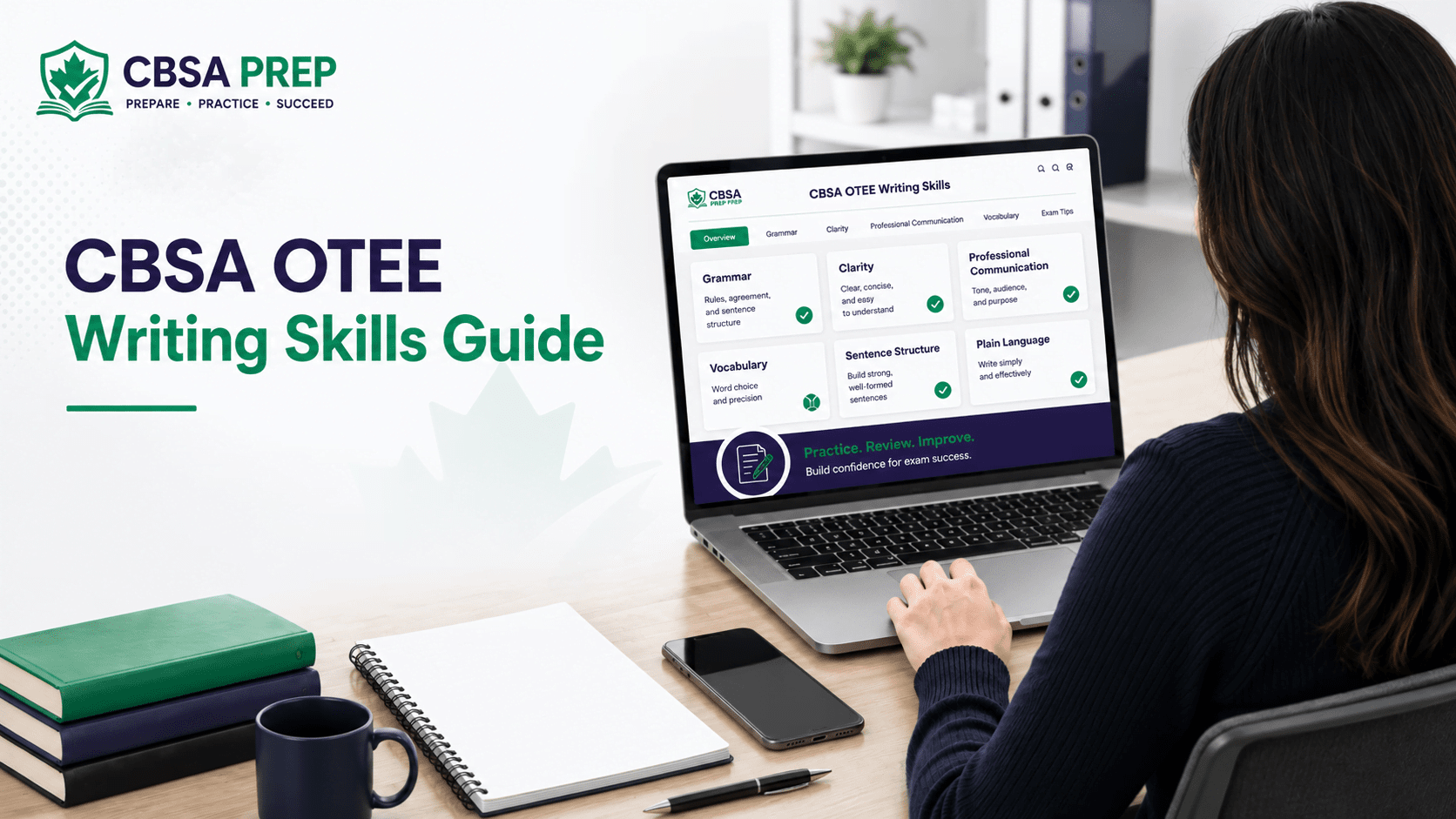
For candidates, this means preparation should cover more than isolated grammar rules. Vocabulary, sentence construction, meaning, clarity, professional tone, and careful instruction-following are all relevant to effective CBSA OTEE Writing Skills practice.
Want to check your current level before beginning focused preparation? Try the Free CBSA OTEE Practice Test.
CBSA OTEE Quick Facts
| Item | Current Information |
|---|---|
| Exam | Officer Trainee Entrance Exam |
| Agency | Canada Border Services Agency |
| Delivery | Online |
| Questions | 117 multiple-choice questions |
| Time limit | 135 minutes |
| Completion window | One week after receiving access |
| Once started | The exam must be completed in the same sitting |
| Prior CBSA knowledge | Not required |
| Competencies | Reasoning Skills, Analytical Thinking, Client Service Orientation, and Writing Skills |
| Writing format | Multiple-choice, not an essay |
| Public Writing Skills samples | Word meaning and sentence construction |
| Exact Writing Skills question count | Not publicly specified |
The current exam structure, competency definitions, and public samples are available on the CBSA’s Entrance Exam for Officer Trainees page.
What Do CBSA OTEE Writing Skills Measure?
CBSA OTEE Writing Skills measure your ability to understand and recognize written communication that is:
- Clear
- Correct
- Written in plain language
- Appropriate for its intended audience
- Organized in a suitable style and form
This does not mean that every question will ask you to edit a formal report. The official definition describes the wider professional competency, while the exam assesses that competency through multiple-choice questions.
A strong candidate should be able to distinguish between language that is merely grammatically possible and language that communicates the intended meaning accurately and efficiently.
What Do the Official Writing Skills Samples Show?
The CBSA currently provides two public Writing Skills examples.
One asks candidates to identify a pair of words with the same meaning. The other requires candidates to arrange a group of words into a complete sentence and then follow an additional instruction based on that sentence.
These samples highlight three important preparation areas:
- Understanding precise word meanings
- Recognizing logical sentence construction
- Following multi-step written instructions accurately
However, two samples cannot reveal the complete live question bank. The CBSA does not publicly confirm a fixed grammar section, a separate punctuation section, a paragraph-sequencing section, or the exact number of questions assigned to each Writing Skills task.
Candidates should therefore prepare broadly without treating third-party predictions as official exam information.
The Main Areas to Practise
Vocabulary and Word Meaning
Vocabulary preparation is not simply about learning difficult words. You need to understand the precise relationship between words.
Useful areas include:
- Synonyms
- Antonyms
- Near-synonyms
- Commonly confused words
- Meaning in context
- Formal and plain-language alternatives
Two words may relate to the same general topic without having the same meaning. For example, “verify” and “confirm” are close in meaning, while “verify” and “estimate” describe different actions.
When studying vocabulary, learn how a word functions in a sentence rather than memorizing one isolated definition.
Grammar and Sentence Construction
Grammar helps ensure that a sentence communicates its meaning correctly.
Important preparation areas include:
- Subject–verb agreement
- Verb tense consistency
- Pronoun reference
- Modifier placement
- Parallel structure
- Complete sentences
- Fragments and run-on sentences
- Logical word order
You do not need to memorize the technical name of every grammar rule. You do need to recognize when a sentence is incomplete, inconsistent, confusing, or incorrectly constructed.
Plain Language and Clarity
Plain language is part of the official CBSA Writing Skills definition.
Clear writing normally:
- States the main point directly
- Uses familiar and accurate words
- Avoids unnecessary repetition
- Makes the actor and action easy to identify
- Presents information in a logical order
- Removes wording that does not add meaning
For example: “Due to the fact that the form was incomplete, the request could not be processed.”
A clearer version is: “The request could not be processed because the form was incomplete.”
The second sentence preserves the meaning while reducing unnecessary wording.
Plain language does not always mean choosing the shortest option. An answer must still be complete, precise, and appropriate for its purpose.
Professional Tone and Audience
The best wording depends partly on who will read it and why it is being written.
Professional communication is generally:
- Respectful
- Clear
- Accurate
- Neutral
- Purposeful
- Free from unnecessary emotion
- Appropriate for the reader
An option can be grammatically correct but still be too vague, excessively formal, dismissive, or unsuitable for the intended audience.
Avoid assuming that the most complicated sentence is the most professional. Clear language is usually more effective than inflated or bureaucratic wording.
Careful Instruction-Following
The official sentence-construction sample includes more than one step. Candidates must first form a sentence and then use information from it to select the final response.
This shows why reading the complete instruction matters.
Before answering, identify:
- What you must do first
- Whether another step follows
- What form the final answer must take
- Whether the question asks for a word, letter, pair, or response option
A candidate may understand the language task correctly but still select the wrong answer by missing the final instruction.
A Five-Step Method for CBSA OTEE Writing Skills Questions
The following method is an independent preparation framework, not an official CBSA scoring formula.
Step 1: Read the Full Instruction
Determine exactly what the question requires before examining the choices in detail.
Look for words such as:
- Same
- Opposite
- Correct
- Clearest
- Best
- First
- Last
- Complete
A single instruction word can change the required answer.
Step 2: Identify the Main Language Task
Decide whether the question mainly concerns:
- Word meaning
- Sentence construction
- Grammar
- Clarity
- Tone
- Punctuation
- Instruction-following
This helps prevent you from searching for irrelevant errors.
Step 3: Remove Clearly Incorrect Options
Eliminate choices containing an objective problem, such as:
- Incorrect word meaning
- Subject–verb disagreement
- Inconsistent verb tense
- A sentence fragment
- Illogical word order
- An unclear reference
- Failure to follow the instruction
Step 4: Compare Meaning and Clarity
When more than one option appears grammatically possible, ask:
- Which sentence communicates the intended meaning most precisely?
- Does either option create ambiguity?
- Has important information been removed?
- Is any wording unnecessarily complicated?
- Is the tone appropriate for the reader?
Step 5: Check the Instruction Again
Before selecting your answer, return to the original direction.
Confirm that you have completed every required step and selected the type of response requested.
For deeper practice with timed questions and detailed explanations, explore the complete CBSA OTEE Practice Exams.
Common CBSA OTEE Writing Skills Mistakes
Assuming There Is an Essay
The current OTEE is multiple-choice. Spending most of your preparation time writing extended essays does not directly match the published exam format.
Choosing the Shortest Option Automatically
Clear writing is often concise, but the shortest sentence may be incomplete, vague, or inaccurate.
Choosing the Most Formal Option
Professional writing does not require unnecessary jargon or outdated bureaucratic expressions. Plain language is specifically included in the official competency definition.
Checking Grammar Without Checking Meaning
A sentence may follow a grammar rule and still communicate the wrong idea. Meaning should always remain central.
Selecting a Familiar Word
A familiar word is not necessarily the correct synonym or the best fit for the context. Compare exact meanings.
Missing Part of the Instruction
Multi-step questions can punish rushed reading. Complete each stage in the order requested.
Memorizing Fixed Answers
Repeating identical questions may help you remember answer positions without improving your language skills. Varied practice and answer explanations are more useful.
How to Prepare Efficiently
Begin With a Diagnostic
Use a short mixed practice test to identify whether your main difficulty involves:
- Vocabulary
- Grammar
- Sentence structure
- Plain language
- Professional tone
- Careful reading
- Time management
Your study plan should be based on actual weaknesses rather than assumptions.
Practise One Weak Area at a Time
Focused practice can help you correct specific problems before moving into mixed questions.
For example, you might spend one session on subject–verb agreement, another on vocabulary relationships, and another on plain-language editing.
Review Every Answer Choice
Do not review only the correct answer.
For each incorrect option, identify whether the problem involves:
- Meaning
- Grammar
- Word order
- Ambiguity
- Tone
- Unnecessary wording
- Failure to follow instructions
Understanding why an option is wrong is more valuable than memorizing its letter.
Keep a Simple Error Log
Record recurring mistakes under clear categories.
| Error Type | What to Review |
|---|---|
| Vocabulary | Definitions, synonyms, antonyms, and context |
| Grammar | Agreement, tense, pronouns, and modifiers |
| Clarity | Wordiness, vague references, and sentence structure |
| Tone | Audience, formality, and professionalism |
| Instructions | Missed stages, negatives, or required response format |
| Timing | Overthinking or rereading excessively |
This allows you to focus future practice where it will have the greatest effect.
Add Timing Gradually
The full OTEE contains 117 questions within 135 minutes. Candidates need to read accurately while avoiding excessive time on one item.
Begin with untimed learning, then progress to:
- Short timed Writing Skills sets
- A dedicated competency practice exam
- A mixed mini exam
- A full-length timed simulation
Speed should be developed after your decision-making process becomes reliable.
Practise CBSA OTEE Writing Skills With Explanations
CBSA PREP is an independent OTEE preparation platform built around the competency areas publicly identified by the CBSA. It is not affiliated with or endorsed by the Canada Border Services Agency and does not provide official, leaked, or recalled exam questions.
Current full access includes:
- 170+ Writing Skills practice questions
- A dedicated 24-question Writing Skills practice exam
- A 27-minute competency practice limit
- Grammar, vocabulary, clarity, punctuation, tone, and professional communication practice
- Full answer explanations
- Fresh retake pools
- Shuffled answer options
- Mixed and full-length OTEE practice exams
Answer explanations are important because they show whether an option fails because of meaning, grammar, structure, ambiguity, tone, or failure to follow the instruction.
Use CBSA OTEE Practice Exams when you are ready to move from individual skill review to structured and timed preparation.
Key Takeaways
- CBSA OTEE Writing Skills are assessed through multiple-choice questions, not an essay.
- The official competency emphasizes clear and correct writing, plain language, style, form, and intended audience.
- Public CBSA samples demonstrate word meaning, sentence construction, and instruction-following.
- The complete live question-type breakdown is not publicly available.
- Grammar matters, but meaning and clarity must also be considered.
- The shortest or most formal option is not automatically correct.
- Read every stage of the instruction before choosing an answer.
- Review incorrect options to understand the specific language error.
- Build accuracy first, then introduce timed practice.
CBSA OTEE Writing Skills FAQ
What are CBSA OTEE Writing Skills?
CBSA OTEE Writing Skills refer to the ability to recognize clear, correct, plain-language written communication in a style and form appropriate for the intended audience.
Does the CBSA OTEE Writing Skills assessment include an essay?
No. The current OTEE consists of multiple-choice questions. Candidates are not required to write an extended essay during the exam.
What types of Writing Skills questions are publicly confirmed?
The official CBSA examples include a same-meaning word task and a word-arrangement task that requires candidates to form a sentence and follow an additional instruction.
Does the OTEE test grammar and punctuation?
Grammar and punctuation support clear and correct writing, making them sensible preparation areas. However, the CBSA does not publish a complete breakdown of all live Writing Skills question types.
Is the shortest sentence usually the best answer?
No. A concise sentence must still be accurate, complete, clear, and appropriate for the intended audience.
Is the most formal sentence usually correct?
Not necessarily. Excessively formal or bureaucratic language can reduce clarity. The official competency specifically includes plain language.
How can I improve my CBSA OTEE vocabulary?
Study precise definitions, synonyms, antonyms, commonly confused words, and meaning in context. Avoid relying only on whether words appear generally related.
Do I need prior CBSA knowledge?
No. The CBSA states that applicants do not require prior knowledge of the agency because the exam questions are hypothetical.
How should I prepare for multi-step Writing Skills questions?
Read the full instruction first, identify each required stage, complete the stages in order, and confirm that your final selection answers the exact question.
Are CBSA PREP questions official CBSA questions?
No. CBSA PREP provides independent practice questions built around publicly available OTEE competency information. It is not affiliated with or endorsed by the CBSA.
Final Preparation Advice
Effective CBSA OTEE Writing Skills preparation is not about learning impressive words or applying one grammar rule to every question.
Focus on five questions:
- What does the instruction require?
- What does the word or sentence actually mean?
- Is the language correct?
- Is the message clear?
- Is it appropriate for the intended audience?
Start with the Free CBSA OTEE Practice Test to identify your current strengths and weaknesses. When you need deeper practice, continue with full CBSA OTEE practice exams featuring timed questions, detailed explanations, and varied retakes.