
If you are searching for OTEE Exam Questions, you probably want one thing: a clear idea of what CBSA-style questions actually look like before you sit the real exam.
That is the right way to prepare.
The CBSA Officer Trainee Entrance Exam is not about memorizing border laws. The questions are hypothetical and are designed to assess how you reason, analyse information, handle client-service situations, and communicate in writing. CBSA confirms that the OTEE assesses four competencies: reasoning skills, analytical thinking, client service orientation, and writing skills.
This guide focuses only on OTEE Sample Questions and OTEE Exam Sample Questions. You will learn how to read the logic behind each type of question, what the official CBSA sample questions are trying to test, and how to practise in a structured way without wasting time on generic question banks that do not match the real OTEE style.
What Do OTEE Exam Questions Actually Test?
OTEE exam questions test how you think under pressure.
The official CBSA sample questions show that the exam is not built around trivia. You are not expected to know CBSA policies, legislation, port procedures, or border rules before writing the test. Instead, the questions focus on practical thinking skills.
Most OTEE-style questions fall into four areas:
- Reasoning Skills: finding patterns, spotting differences, checking details, and drawing logical conclusions.
- Analytical Thinking: reviewing information, prioritizing tasks, comparing facts, and choosing the most logical next step.
- Client Service Orientation: choosing professional, fair, calm, and policy-aware responses in service situations.
- Writing Skills: understanding word meaning, sentence clarity, sentence order, and written communication.
That is why good OTEE Exam Sample Questions should not feel like random brain teasers. They should feel close to the kind of thinking shown in the official CBSA examples.
Why Official CBSA OTEE Sample Questions Matter Most
The official CBSA examples should be your starting point because they show the real style of the test better than most public practice questions.
Many public OTEE-style questions online are either too generic, too easy, too unrelated, or closer to old public-service test material than the current CBSA OTEE. That does not mean every third-party question is useless. It means you should judge every practice question by one standard:
Does this question train the same competency shown in the official CBSA examples?
If it does, it can help.
If it does not, it may waste your time.
That is also how CBSA PREP builds practice material: questions should be competency-based, timed, explainable, and close to the reasoning style applicants need for the real OTEE.
For more structured practice, you can try our free OTEE practice test after reviewing the examples below.
OTEE Sample Questions by Competency
Below are original OTEE Sample Questions designed to help you understand the logic behind each question type. These are not official CBSA questions, but they are written to reflect the same competency areas shown on the official CBSA OTEE page.
Read each question carefully before checking the answer. The explanation matters more than the answer itself.
Reasoning Skills Sample Questions
Reasoning questions often test whether you can compare information accurately, notice small differences, and avoid careless assumptions. In the official CBSA samples, this can include detail checking, visual comparison, number patterns, and logical matching.
Sample Question 1: Detail Checking
A supervisor gives you the following information:
Original request
- Client: North Coast Tools
- Reference number: NCT-4827
- Items: 16 inspection kits, 9 safety vests, 12 replacement seals
- Delivery location: Bay 4
- Delivery time: before 14:30
- Special note: Call the supervisor if the replacement seals are missing.
Which entered record contains no errors?
A. North Coast Tools, NCT-4827, 16 inspection kits, 9 safety vests, 12 replacement seals, Bay 4, before 14:30, call the supervisor if the replacement seals are missing.
B. North Coast Tools, NTC-4827, 16 inspection kits, 9 safety vests, 12 replacement seals, Bay 4, before 14:30, call the supervisor if the replacement seals are missing.
C. North Coast Tools, NCT-4827, 16 inspection kits, 10 safety vests, 12 replacement seals, Bay 4, before 14:30, call the supervisor if the replacement seals are missing.
D. North Coast Tools, NCT-4827, 16 inspection kits, 9 safety vests, 12 replacement seals, Bay 5, before 14:30, call the supervisor if the replacement seals are missing.
Correct Answer: A
Explanation:
Option A matches every detail in the original request. Option B changes the reference number from NCT to NTC. Option C changes the number of safety vests. Option D changes the delivery location. This type of question tests careful reading, not guessing.
Sample Question 2: Visual Matching / Odd-One-Out
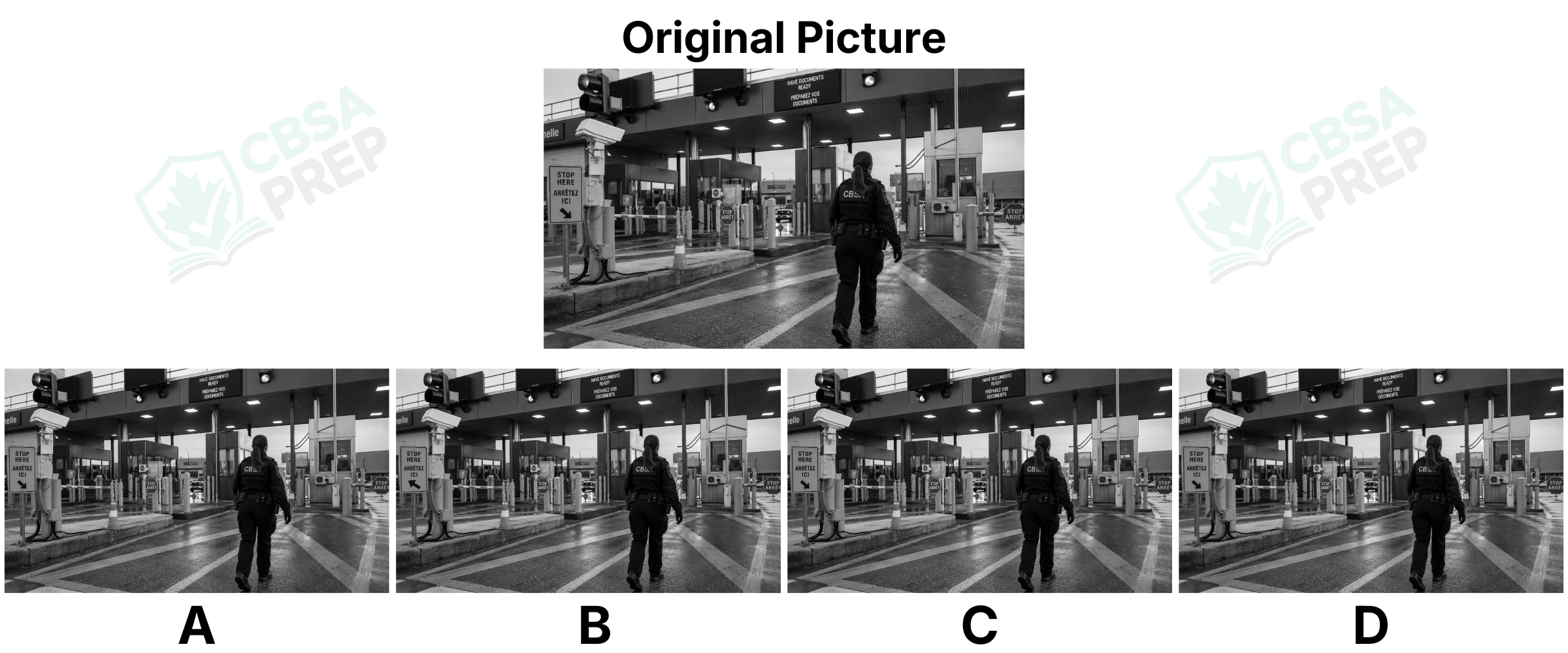
Question: Please identify which of the 4 lettered pictures is not identical to the reference picture.
A. Picture C
B. Picture D
C. Picture B
D. Picture A
Correct Answer: C. Picture B
Explanation: Picture B is not identical to the reference picture. The change is on the left side of the image, at the “STOP HERE / ARRÊTEZ ICI” sign. In the reference picture, the arrow below the text points in the correct direction, but in Option B that arrow is turned in the opposite direction. There are another mismatch, you find it. The other options match the reference more closely, so B is the odd one out.
Analytical Thinking Sample Questions
Analytical thinking questions test how well you sort information, identify what matters most, and make a logical decision based on the facts provided.
These questions are different from simple reasoning questions. Reasoning may ask, “What matches?” Analytical thinking often asks, “What should be handled first?” or “Which option best fits all the conditions?”
Sample Question 3: Prioritizing Information
You are covering a front desk at 9:00 a.m. Four messages are waiting:
- A visitor says they may have left prescription medication in an interview room after an appointment that ended 10 minutes ago.
- A manager asks for a monthly supply count by Friday afternoon.
- A client asks for a brochure to be mailed tomorrow.
- A fire alarm test is scheduled for 3:00 p.m., and a notice should be posted before noon.
Which message should be handled first?
A. The monthly supply count
B. The brochure request
C. The possible prescription medication left behind
D. The fire alarm test notice
Correct Answer: C
Explanation:
The possible prescription medication should be handled first because it is recent, time-sensitive, and may involve personal property that should be secured quickly. The other tasks matter, but they have later deadlines. Analytical thinking questions often reward the option that best balances urgency, risk, and practical responsibility.
Sample Question 4: Scheduling Conditions
You need to schedule three 30-minute interviews and one 30-minute break using the available time slots below:
- 9:00
- 9:30
- 10:00
- 10:30
The conditions are:
- Patel must be interviewed before Singh.
- Chen cannot be interviewed before 10:00.
- The 30-minute slot immediately after Singh must be kept as a break.
Which schedule satisfies all conditions?
A. 9:00 Patel, 9:30 Singh, 10:00 Break, 10:30 Chen
B. 9:00 Singh, 9:30 Break, 10:00 Patel, 10:30 Chen
C. 9:00 Patel, 9:30 Chen, 10:00 Singh, 10:30 Break
D. 9:00 Patel, 9:30 Singh, 10:00 Chen, 10:30 Break
Correct Answer: A
Explanation:
Option A satisfies all three conditions. Patel is before Singh, Chen is not before 10:00, and the slot immediately after Singh is a break. Option B puts Singh before Patel. Option C puts Chen before 10:00. Option D fails because the slot immediately after Singh is not a break.
OTEE Client Service Orientation Sample Questions
Client service orientation questions often feel like situational judgement questions. You may need to choose the response that is most professional, fair, calm, and useful.
The best answer is usually not the softest answer or the strictest answer. It is the response that respects the person, follows the rule, gives clear information, and keeps the situation under control.
Sample Question 5: Most Effective Response
A client is upset because their form was returned for a missing signature. They say they have an appointment in 30 minutes and accuse staff of wasting their time.
What is the most effective response?
A. Tell the client they should have checked the form before submitting it.
B. Process the form anyway because the client is upset and has limited time.
C. Calmly acknowledge the frustration, show the client where the signature is missing, check whether anything else is incomplete, and explain the next step.
D. Tell the client to read the instructions on the website and rejoin the line after fixing the form.
Correct Answer: C
Explanation:
Option C is the strongest response because it is calm, respectful, practical, and still follows the process. It does not ignore the missing signature, but it also does not blame the client. Strong client service means helping the person move forward while maintaining accuracy.
Sample Question 6: Least Effective Response
A caller asks for the status of a file. Your workplace requires identity verification before personal information can be discussed. The caller gives a reference number but refuses to answer verification questions.
Which response is the least effective?
A. Explain that you cannot discuss personal file details until identity is verified.
B. Offer to explain the general process without discussing personal information.
C. Suggest the caller call back when they are ready to complete verification.
D. Provide the file status because the caller sounds frustrated and has a reference number.
Correct Answer: D
Explanation:
Option D is the least effective because frustration and a reference number do not replace identity verification. Client service does not mean ignoring privacy or process requirements. The better responses remain respectful while protecting personal information.
CBSA OTEE Writing Skills Sample Questions
Writing skills questions test whether you understand clear, accurate written communication. You may need to choose the best word, arrange sentences in a logical order, or identify the clearest version of a message.
Strong writing on the OTEE is not about sounding fancy. It is about being accurate, clear, and easy to understand.
Sample Question 7: Sentence Order
Arrange the sentences in the most logical order.
- Finally, submit the completed form to the service desk before 4:00 p.m.
- First, review the form to make sure every required field is complete.
- Then, attach copies of any supporting documents listed in the instructions.
- If a field does not apply, write “N/A” instead of leaving it blank.
Which order creates the clearest paragraph?
A. 2, 4, 3, 1
B. 3, 2, 1, 4
C. 4, 1, 2, 3
D. 1, 3, 4, 2
Correct Answer: A
Explanation:
The best order is 2, 4, 3, 1. First, the reader reviews the form. Then they handle any fields that do not apply. After that, they attach supporting documents. Finally, they submit the completed form. The sequence moves from preparation to completion.
Sample Question 8: Word Meaning
Choose the word that best completes the sentence.
The report should be factual and ________, avoiding personal opinions or assumptions.
A. objective
B. imaginative
C. informal
D. hesitant
Correct Answer: A
Explanation:
“Objective” means based on facts rather than personal feelings or opinions. This is the best fit because the sentence says the report should avoid opinions and assumptions. The other choices do not match the meaning of the sentence.
What These OTEE Exam Sample Questions Teach You
The point of practising OTEE Exam Sample Questions is not to memorize answers. It is to learn how the test thinks.
From the examples above, you can see a few patterns:
- Reasoning questions reward careful comparison.
- Analytical thinking questions reward organized decision-making.
- Client service orientation questions reward calm, fair, process-aware judgement.
- Writing skills questions reward clarity and accuracy.
This is exactly why explanations matter. A question without a good explanation only tells you whether you were right or wrong. A strong explanation teaches you how to approach the next question better.
That is the difference between random practice and useful practice.
How to Use OTEE Sample Questions Properly
The best way to use OTEE sample questions is to slow down during review, even if you practise under timed conditions.
After each question, ask yourself:
- What competency is this testing?
- What detail did I almost miss?
- Why is the correct answer better than the second-best answer?
- Did I choose too quickly?
- Did I rely on opinion instead of the information given?
For client-service questions, pay close attention to the difference between a response that is “nice” and a response that is actually effective. The best option usually helps the person while still respecting the process.
For reasoning and analytical questions, do not trust your first impression too quickly. The wrong answers often change one small detail, one condition, or one deadline.
Why Some Public OTEE Sample Questions Are Not Very Helpful
Public practice questions can be useful, but only when they match the official CBSA competency style.
Some public questions online are too general. They may test basic grammar, random logic, or generic public-service knowledge, but they do not always reflect the way CBSA frames OTEE-style reasoning, analytical thinking, client service, and writing skills.
A good OTEE practice question should have three things:
- A clear competency focus
- One defensible correct answer
- A useful explanation that teaches the logic
If a sample question does not have those three things, it may not help you much.
Practise More OTEE Exam Questions with CBSA PREP
If you want more practice after reviewing these examples, CBSA PREP gives you a structured way to work through OTEE Exam Questions before test day.
Our OTEE Practice Test includes timed practice, competency-mapped questions, answer explanations, and retakes so you can review mistakes and improve your pacing.
The goal is not to memorize a question bank. The goal is to build the kind of thinking the OTEE rewards: careful reading, logical analysis, professional judgement, and clear written communication.
You can also start with our free OTEE practice test if you want a quick way to test your current level before moving into deeper practice.
FAQs About OTEE Exam Questions
What are OTEE Exam Questions?
OTEE Exam Questions are multiple-choice questions used in the CBSA Officer Trainee Entrance Exam. They assess reasoning skills, analytical thinking, client service orientation, and writing skills.
Are OTEE Sample Questions the same as real CBSA questions?
No. Public OTEE Sample Questions are practice examples unless they come directly from the official CBSA website. Practice questions can still be useful if they match the same competency style and include clear explanations.
Where can I find official OTEE Exam Sample Questions?
You can find official examples on the official CBSA OTEE sample questions page. Use those examples as your standard when judging any other practice material.
What type of OTEE Sample Questions should I practise?
Practise questions that cover all four competency areas: reasoning skills, analytical thinking, client service orientation, and writing skills. Do not practise only the question type you find easiest.
Are client service orientation questions like SJT questions?
They can feel similar because you are choosing the best or least effective response to a workplace-style situation. The best answer usually balances professionalism, fairness, clear communication, and respect for the process.
How many OTEE Sample Questions should I practise?
Practise enough to recognize patterns across all four competency areas. A few sample questions can help you understand the style, but full timed practice is better for building speed and consistency.
What is the best way to practise OTEE Exam Questions?
Start with official CBSA examples, study the explanations carefully, then use structured practice questions that are timed and competency-based. You can use CBSA PREP’s OTEE sample questions to practise with explanations and review your weak areas.
Final Thoughts
The best OTEE Exam Questions are not just questions with answers. They are questions that teach you how to think more clearly.
Start with the official CBSA examples. Study the logic behind each competency. Then practise with high-quality OTEE Sample Questions that are relevant, timed, and supported by clear explanations.
If you can understand why an answer is right, why the other options are weaker, and what competency the question is testing, you will be much better prepared for the real OTEE.
For more structured practice, start with the OTEE Practice Test from CBSA PREP and use each explanation to sharpen your reasoning, judgement, and writing skills before exam day.