Many applicants search for the cbsa otee exam passing score because they want one simple number. But the OTEE is not something you should approach with a “just pass” mindset.
According to CBSA public information, the Officer Trainee Entrance Exam includes 117 multiple-choice questions, must be completed within 135 minutes once started, and assesses four competencies: Reasoning Skills, Analytical Thinking, Client Service Orientation, and Writing Skills. CBSA also states that candidates need 60% correct in each competency to be successful.
That last part matters most: the passing score is not only about your total performance. You need to be strong across every competency.
Quick Answer: What Is the CBSA OTEE Exam Passing Score?
The cbsa otee exam passing score is listed in CBSA public materials as 60% correct in each competency. That means you should not prepare only for an overall average. You need to build enough accuracy in each assessed area: Reasoning Skills, Analytical Thinking, Client Service Orientation, and Writing Skills.
In simple terms, a weak section can put your result at risk even if you feel confident in the other areas.
That is why a focused OTEE Practice Test is useful before your real attempt. It helps you see whether you are balanced across all four competencies, instead of only feeling generally prepared.
Why the Passing Score Is Not the Real Target
The minimum score tells you what is required to be successful. It does not tell you what is smart to aim for.
CBSA’s selection process can be long and competitive. CBSA states that the full process can take up to 18 months, and public applicant discussions also show that candidates may wait weeks or months between stages after the OTEE.
Because of that, your goal should not be to barely reach the cbsa otee exam passing score. Your goal should be to build stronger competency-wise performance before test day.
A higher level of preparation can help you reduce risk in two ways:
First, it gives you more room for mistakes under time pressure.
Second, it helps you avoid depending on one strong skill area while another competency stays weak.
The Four Competencies Behind the OTEE Passing Score
CBSA says the OTEE assesses four important competencies. Each one requires a different type of thinking.
Reasoning Skills
Reasoning questions test your ability to draw conclusions, notice patterns, compare details, and solve problems using the information provided.
These questions can feel simple at first, but small details matter. Public applicant discussions often mention time pressure, “find the difference” style questions, and uncertainty about how much to study.
Analytical Thinking
Analytical Thinking questions require you to break down information, identify what matters, and choose the conclusion or action best supported by the facts.
This is where many applicants lose marks by assuming too much or rushing through scenario details.
Client Service Orientation
Client Service Orientation is not just about choosing the “nicest” answer. It is about fairness, professionalism, timeliness, completeness, courtesy, and practical judgement.
For a CBSA-related role, this competency matters because the job involves dealing with people, procedures, pressure, and public service expectations.
Writing Skills
Writing Skills questions test clarity, correctness, grammar, sentence structure, and professional communication.
This section can be easy to underestimate. But if 60% is required in each competency, writing cannot be treated as a minor section.
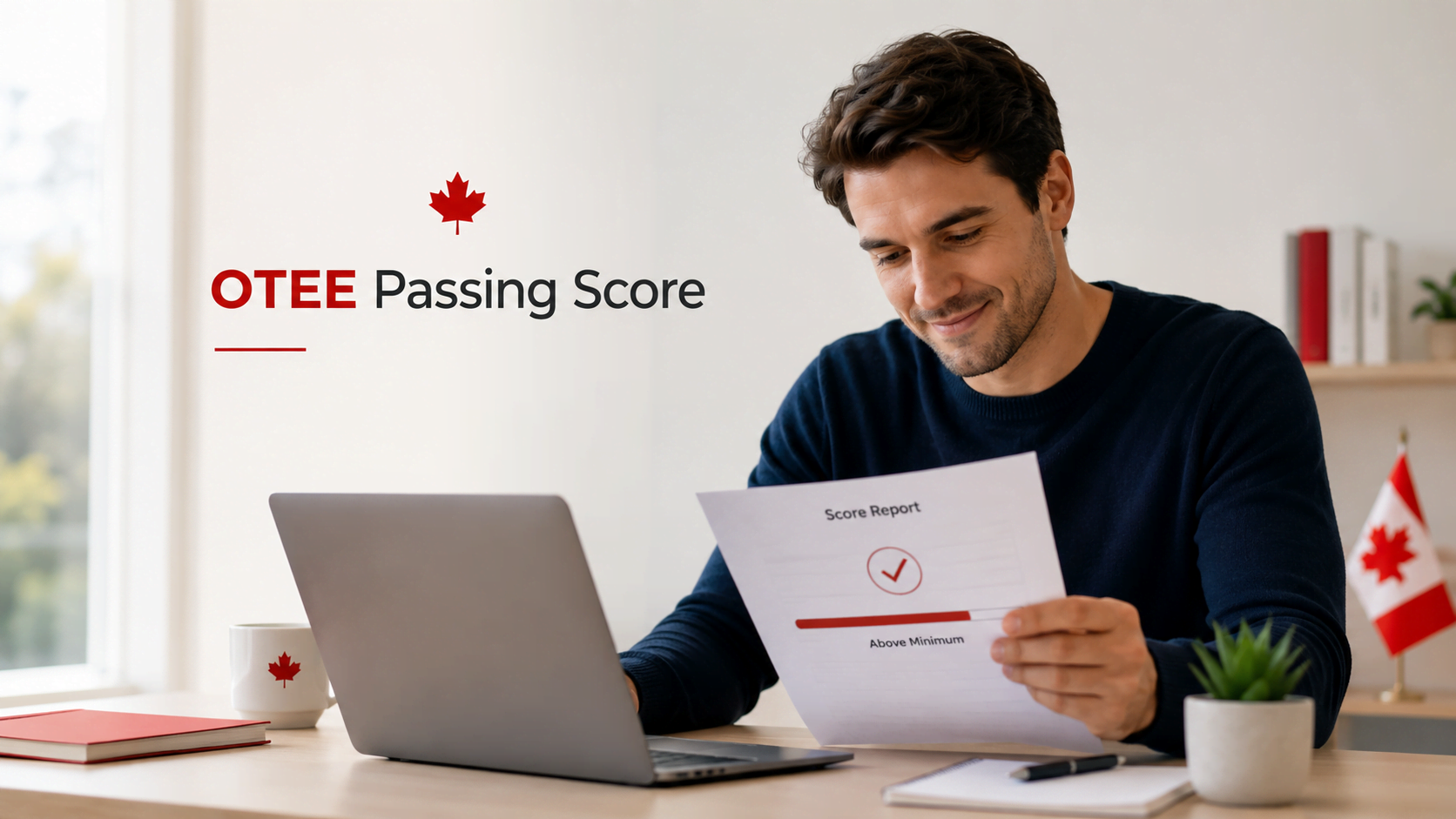
What Happens If You Fail the OTEE?
This is one of the biggest reasons the cbsa otee exam passing score matters.
CBSA states that successful OTEE results are valid indefinitely. However, if you receive an unsuccessful result, your candidacy is terminated. If you want to re-apply, you may rewrite the OTEE one full year after your initial attempt. CBSA also warns that rewriting before the waiting period ends makes the new result invalid and starts a new waiting period.
That one-year wait is a serious consequence. It is why applicants should not go into the exam cold or depend on general confidence alone.
Before your real attempt, use a timed CBSA OTEE Practice Test to check your pacing, accuracy, and weak areas.
Does Passing the OTEE Mean You Move Forward Quickly?
Not always.
Passing the OTEE keeps you in the selection process, but it does not guarantee that every next step will happen immediately. CBSA’s published timeline says the process can take up to 18 months. Applicant discussions also show varied experiences, with some people receiving results in a few weeks while others describe longer waits between stages.
This is another reason to aim beyond the minimum. You cannot control every hiring timeline, but you can control how seriously you prepare before your OTEE attempt.
How to Prepare Above the CBSA OTEE Exam Passing Score
To prepare properly, do not just read about the test. Practise under conditions that feel closer to the real exam.
CBSA states that the official OTEE has 117 questions and a 135-minute limit once started. That means pacing matters. Accuracy matters. Endurance matters.
Here is a simple preparation approach:
Start with a diagnostic practice test to identify your weaker competencies.
Review every explanation, especially for questions you guessed correctly.
Practise each competency separately so one weak area does not pull you below the requirement.
Then move into timed practice so you can answer accurately under pressure.
CBSA Prep’s free OTEE Practice Test gives you a 12-minute, 10-question OTEE-style quiz across all four competencies, with instant results, explanations, and retake options. It is designed as a short diagnostic to help applicants practise under timed conditions and identify areas that need more work.
The point is not only to reach the minimum passing score. The point is to train for stronger, more balanced performance before your official attempt.
Final Thoughts on the CBSA OTEE Exam Passing Score
The cbsa otee exam passing score is important, but it should not be your final goal.
CBSA public materials state that candidates need 60% correct in each competency to be successful. That means you need balanced preparation across Reasoning Skills, Analytical Thinking, Client Service Orientation, and Writing Skills.
If you fail, you may have to wait one full year to rewrite the exam. If you pass, the process can still take time. So the smartest approach is to prepare before test day with a clear focus on every competency.
Start with a free timed OTEE Practice Test and use your results to improve the areas that matter most.
FAQs About the CBSA OTEE Exam Passing Score
What is the cbsa otee exam passing score?
CBSA public materials state that candidates need 60% correct in each competency to be successful. The OTEE assesses Reasoning Skills, Analytical Thinking, Client Service Orientation, and Writing Skills.
Is the OTEE passing score based on the total score?
The key point is competency-wise performance. CBSA states that 60% correct in each competency is required, so applicants should not prepare as if only the overall average matters.
What happens if I fail the CBSA OTEE?
CBSA states that unsuccessful results terminate your candidacy. You may rewrite the OTEE one full year after your initial attempt. If you rewrite too early, the new result will not be valid and a new waiting period begins.
Do I need CBSA knowledge to pass the OTEE?
No. CBSA states that OTEE questions are hypothetical and applicants do not require prior CBSA knowledge. The exam assesses competencies such as reasoning, analytical thinking, client service orientation, and writing skills.
How can I prepare for a higher OTEE score?
Use competency-based, timed practice. A free CBSA OTEE Practice Test can help you check your performance across the four assessed areas, review explanations, and identify what to improve before your real exam.