
CBSA OTEE Reasoning Skills assess how well you can draw conclusions or inferences from information to solve problems. CBSA states that the questions are hypothetical and that applicants do not require prior knowledge of the agency. Your task is to work carefully with the information presented and choose the answer that is logically supported.
The official CBSA page currently provides three Reasoning Skills samples: an identity code comparison, a visual comparison, and a number sequence. Together, these examples demonstrate the importance of accurate observation, controlled comparison, pattern recognition, and careful verification.
Many applicants perform well when practising without a timer but become less accurate when they try to work too quickly. Effective preparation should therefore begin with a reliable method and introduce time pressure only after that method becomes consistent.
Want to establish your current baseline? Begin with the Free CBSA OTEE Practice Test, then review the types of errors affecting your accuracy and pace.
CBSA OTEE Reasoning Skills: Key Takeaways
- Reasoning Skills are one of four separate competencies assessed on the OTEE.
- The official Reasoning Skills samples include identity code comparison, visual comparison, and a number sequence.
- Answers should be based on the information provided, not on outside assumptions.
- A consistent checking order is safer than random scanning.
- A sequence rule should explain every relevant term, not only the final two.
- Accuracy should be established before strict timing is introduced.
- Wrong answers should be reviewed according to their cause.
- Full-length practice can help develop concentration and overall pacing across the four competencies.
Current CBSA OTEE Quick Facts
| Item | Official information |
|---|---|
| Exam | Officer Trainee Entrance Exam |
| Agency | Canada Border Services Agency |
| Delivery | Online |
| Questions | 117 multiple-choice questions |
| Time limit | 135 minutes |
| Testing window | Candidates have one week in which to complete the test |
| Once started | The test must be finished once it has begun |
| Prior CBSA knowledge | Not required |
| Question context | Hypothetical |
| Competencies | Reasoning Skills, Analytical Thinking, Client Service Orientation, and Writing Skills |
| Reasoning Skills focus | Drawing conclusions or inferences from information to solve problems |
Applicants should confirm current requirements and review the published examples through the official CBSA Officer Trainee Entrance Exam information.
What Do CBSA OTEE Reasoning Skills Assess?
CBSA describes Reasoning Skills as the ability to draw conclusions or inferences from information to solve problems. In practical terms, you must examine the information provided, identify the relevant relationship or difference, and determine which conclusion follows.
Depending on the task, this may involve:
- comparing details accurately;
- identifying a discrepancy;
- recognizing a numerical or visual relationship;
- distinguishing a match from a non-match;
- testing whether an answer fits the available evidence; or
- eliminating a choice that conflicts with the information.
A strong reasoning answer is evidence-based. It should not depend on personal preference, occupational experience, or what normally happens outside the question. A single character, number, position, orientation, or relationship can affect the answer. Careful reading and observation are therefore central parts of Reasoning Skills.
What the Official CBSA Reasoning Skills Samples Show
The official CBSA exam page currently provides three sample Reasoning Skills questions. These samples confirm examples of how the competency can be assessed. They should not, however, be treated as a complete list of every format that could appear in a future OTEE.
1. Identity Code Comparison
The first official sample presents two lists of identity codes and asks how many discrepancies appear between them. The differences include small character changes, such as:
- one digit being replaced by another;
- a letter appearing where the corresponding code contains a number; and
- a digit changing near the end of a code.
The task rewards controlled comparison. Two codes may appear identical at first glance even though one character is different.
How to approach identity code questions
Compare corresponding entries in the same order. For each pair:
- Check that the codes have the same length.
- Compare the letters.
- Compare the digits from left to right.
- Watch for similar-looking characters, such as
1,I,0, andO. - Confirm exactly what the question asks you to count.
Do not rely on the general appearance of the code. Compare each character by position.
2. Visual Comparison
The second official sample asks which of four pictures is not identical to a reference picture. This requires more than recognizing the general shape. A small change in orientation, position, spacing, or arrangement may determine the answer.
How to approach visual comparison questions
During practice, use the same inspection order for every option. For example, examine:
- the top section;
- the centre;
- the bottom section;
- the left and right edges; and
- the orientation of individual elements.
Look for:
- rotation;
- reversed direction;
- missing or added elements;
- changes in spacing;
- differences in position; and
- small changes near an edge or corner.
A consistent process helps prevent repeated checking of one area while another area is overlooked.
3. Number Sequence
The third official sample asks for the next number in this sequence:
3, 9, 4, 16, 5, 25, 6
The terms alternate between an integer and its square:
- 3 followed by 9;
- 4 followed by 16;
- 5 followed by 25;
- 6 followed by 36.
The next number is therefore 36.
How to approach number sequences
Do not accept the first rule that appears to fit part of the sequence. Instead:
- Examine the relationship between adjacent terms.
- Check whether two patterns alternate.
- Consider multiplication, division, squares, differences, and positional relationships.
- Test the proposed rule against the earlier terms.
- Confirm that the rule predicts the next term exactly.
A useful rule must explain the complete pattern, not only the final part of it.
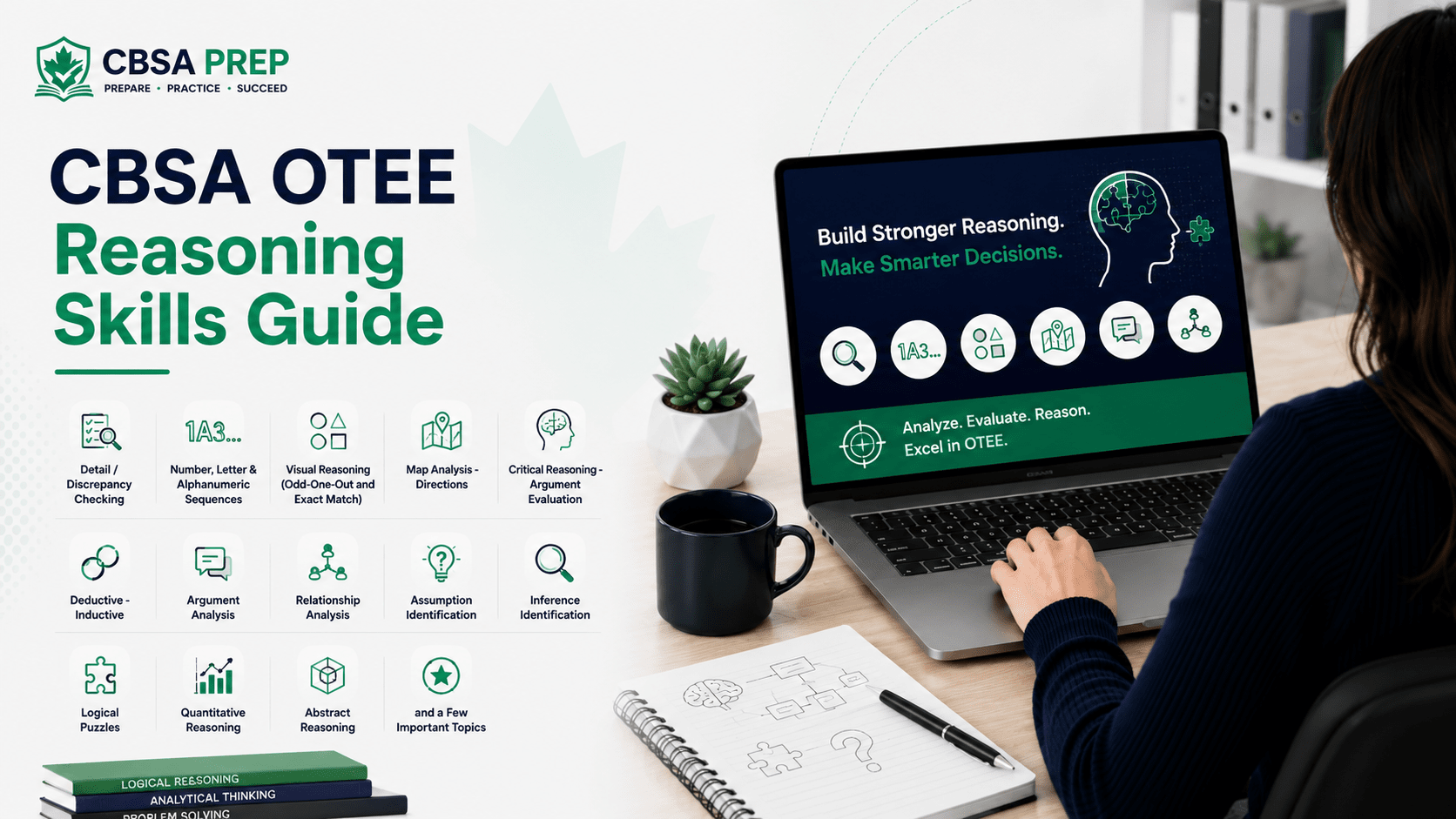
Are These the Only OTEE Reasoning Question Types?
CBSA does not state that its three published samples represent the complete Reasoning Skills question bank. They are confirmed examples made publicly available by the agency. Additional activities—such as letter patterns, structured comparison, logical inference, or rule-application exercises—may help develop transferable reasoning ability. However, preparation providers should distinguish clearly between:
- question formats shown in official CBSA samples; and
- supplementary exercises used to develop related skills.
A useful practice exercise should not be presented as a confirmed live OTEE question type unless CBSA identifies it as one.
Reasoning Skills and Analytical Thinking Are Not the Same
Reasoning Skills and Analytical Thinking both involve logic, but CBSA lists them as separate competencies.
| Competency | Official focus | Practical distinction |
|---|---|---|
| Reasoning Skills | Drawing conclusions or inferences from information to solve problems | Determining what follows from a comparison, pattern, or relationship |
| Analytical Thinking | Using a logical process to break down and work through a situation or problem | Organizing a situation, applying conditions, and reaching an outcome |
A Reasoning Skills question may ask you to identify a discrepancy, recognize a pattern, or find the picture that differs from a reference. An Analytical Thinking question may give you a workplace scenario, define several categories, and require you to apply those definitions to reach a decision. This distinction matters because the two competencies require different preparation methods.
For a detailed approach to scenario questions, read the CBSA OTEE Analytical Thinking Guide: How to Approach Scenario Questions.
How to Approach CBSA OTEE Reasoning Questions
A useful method should be simple enough to apply consistently without creating extra work.
Step 1: Identify the exact task
Before attempting the answer, determine what you are being asked to find. For example:
- Are you counting discrepancies?
- Are you identifying a picture that does not match?
- Are you finding the next number in a sequence?
- Are you deciding which conclusion is supported by the information?
The task determines the method. Code comparison requires controlled checking. Visual comparison requires systematic inspection. A sequence requires pattern testing.
Step 2: Focus on the information that controls the answer
Identify the relationship or detail that matters.
For an identity code, this may be the exact position of each character.
For a visual comparison, it may be direction, spacing, orientation, or a missing element.
For a sequence, it may be an alternating relationship rather than a single change between every adjacent number.
Do not assume that every detail deserves equal attention. Focus on what the question requires you to compare or infer.
Step 3: Use a consistent checking order
Random inspection increases the risk of missed details and unnecessary rechecking.
During practice:
- compare codes from the same starting position;
- inspect images in the same order;
- test a pattern against all available terms; and
- evaluate answer choices using the same criteria.
A repeatable process reduces avoidable errors.
Step 4: Eliminate choices for a specific reason
Elimination is useful when it is supported by evidence.
Remove a choice because:
- it contains a mismatch;
- it is identical when the question asks for the non-identical option;
- it breaks the sequence;
- it requires information that was not provided; or
- another choice fits the evidence more completely.
Do not eliminate an answer simply because it looks unusual.
Step 5: Perform one focused final check
Before moving on, ask:
- Did I answer the exact question?
- Did I overlook a word such as not?
- Does my pattern explain the complete sequence?
- Did I count entries or character differences correctly?
- Am I relying on an unsupported assumption?
The purpose of the final check is to catch a preventable mistake, not to solve the question a second time.
Original CBSA OTEE Reasoning Practice Examples
The following examples were created for teaching purposes. They are not official or live CBSA OTEE questions.
Identity Code Example
Compare the codes:
Reference: KT408615
Comparison: KT480615
The codes contain the same letters and digits, but the second and third digits in the numeric portion—0 and 8—appear in reversed positions. The codes are therefore not identical.
The lesson is that two codes can contain the same characters and still be different when those characters appear in different positions.
Number Sequence Example
Consider the sequence:
2, 6, 3, 9, 4, 12, 5
The relationship alternates between an integer and that integer multiplied by three:
- 2 followed by 6;
- 3 followed by 9;
- 4 followed by 12;
- 5 followed by 15.
The next term is therefore 15.
Before accepting this answer, check that the relationship explains every pair. Verification separates a supported pattern from a plausible guess.
Time Management for CBSA OTEE Reasoning Skills
The OTEE contains 117 questions and has a duration of 135 minutes. This gives an overall average of approximately 69 seconds per question. That figure is a general pacing reference. It is not a rule requiring you to spend exactly the same amount of time on every question. Some comparison questions may take less time. A more complex sequence or set of instructions may take longer.
Understand the task before trying to work faster
Attempting to save time before understanding the question can produce an error that careful reading would have prevented. First develop an accurate method. Then improve your pace by removing unnecessary steps.
Avoid random rechecking
Repeatedly checking the same characters or areas of an image wastes time and can increase uncertainty. A fixed inspection order helps you know what has already been reviewed.
Do not depend on an arbitrary time limit for every question
Advice such as leaving every question after exactly 60 or 90 seconds may appear simple, but individual questions can differ in complexity. During practice, record how long different tasks take and identify where your own delays occur.
Do not assume another competency will always be faster
Some candidates may complete certain Writing Skills or Client Service Orientation questions quickly. Others may not. CBSA does not state that one competency will always be easier or faster than another. Build your pacing strategy from your own timed results.
Follow the assessment instructions you receive
CBSA confirms the overall duration and states that the test must be completed once it has begun. Follow the instructions in your invitation and testing platform. Do not assume that the navigation or review functions in a practice system will be identical to those in the actual assessment.
For a broader overview, read CBSA OTEE Exam Format 2026: Questions, Time Limit, and Competencies.
How to Practise CBSA OTEE Reasoning Skills Effectively
1. Establish a baseline
Begin with a short practice assessment that covers more than one competency. For Reasoning Skills, record:
- your accuracy;
- your completion time;
- the task formats that caused errors;
- whether you missed details or misunderstood instructions; and
- whether time pressure affected your performance.
A baseline helps you choose practice based on evidence rather than guesswork.
2. Learn the method without strict timing
When learning a task, focus first on accurate technique.
For identity codes, compare in a fixed order.
For visual questions, inspect each area systematically.
For sequences, verify the proposed relationship against the full series.
Understand the method before attempting to perform it quickly.
3. Target the cause of repeated errors
Focused practice is useful when the same type of mistake appears repeatedly. For example:
- If you miss individual characters, practise short identity code comparisons.
- If you overlook rotation, practise visual orientation checks.
- If you choose incomplete patterns, practise testing rules against every term.
- If you misread instructions, restate the task before solving.
The goal is not simply to complete more questions. It is to correct the process causing the error.
4. Introduce controlled timing
Once your method is consistent, complete short timed sets.
Track speed and accuracy together. A faster time is not an improvement if your error rate rises sharply. The goal is to reach sound conclusions with less unnecessary rereading or hesitation.
5. Review errors by category
A percentage score shows how many answers were correct. It does not explain why the other answers were wrong.
Use an error log such as this:
| Error type | Likely cause | Corrective practice |
|---|---|---|
| Comparison error | A character or position change was missed | Compare in a fixed order |
| Visual error | An area or orientation was overlooked | Inspect the image by sections |
| Pattern error | The rule explained only part of the sequence | Test it against every term |
| Instruction error | The task or negative wording was misread | Restate the question before solving |
| Assumption error | Information was added that was not provided | Require evidence for each conclusion |
| Timing error | The method became unreliable under pressure | Use shorter controlled timed sets |
| Overchecking | The same detail was reviewed repeatedly | Use one systematic check and one final verification |
For each incorrect answer, record:
- what the question required;
- what approach you used;
- why that approach failed; and
- what you will do differently next time.
6. Move into full-length practice
Short reasoning sets develop individual skills, but they do not reproduce the concentration required for a 117-question assessment. A full simulation can help you observe:
- how your pace changes over time;
- whether your comparison accuracy declines when you are tired;
- whether one difficult question affects the next;
- how well you maintain concentration across the four competencies; and
- whether your review process remains efficient.
CBSA does not publicly describe the exact live order of the competencies. A preparation platform should therefore develop broad readiness rather than claim to reproduce an undisclosed sequence exactly.
For more complete preparation, CBSA OTEE Practice Exams provide timed practice, competency-mapped questions, full answer explanations, and smart retakes.
Common CBSA OTEE Reasoning Practice Mistakes
1. Practising only number sequences
Number sequences are one official sample format, but the published examples also include identity code and visual comparisons. Better approach: Develop pattern recognition, comparison accuracy, and systematic visual checking.
2. Presenting every practice exercise as confirmed exam content
A useful exercise is not automatically a confirmed live OTEE format. Better approach: Distinguish official examples from supplementary skill-development questions.
3. Memorizing repeated answers
A repeated question may feel easier because you remember the answer rather than because your reasoning has improved. Better approach: Use fresh questions, altered details, and retakes after reviewing your method.
4. Choosing the first plausible pattern
A rule may explain the final two terms but fail elsewhere in the sequence. Better approach: Test the relationship against every relevant term.
5. Scanning instead of comparing
A quick glance may identify a large difference while missing a single character or small rotation. Better approach: Compare information in a fixed order.
6. Adding assumptions
An answer may sound reasonable while still going beyond the information supplied. Better approach: Identify the evidence that directly supports the conclusion.
7. Focusing only on speed
Fast practice with poor accuracy reinforces unreliable habits. Better approach: Establish a sound method, then improve pace while protecting accuracy.
8. Skipping detailed review
Knowing the correct option does not explain why the mistake occurred. Better approach: Classify the error and choose a specific corrective action.
How to Measure Improvement
Do not judge progress only by how many questions you have completed. Your CBSA OTEE Reasoning Skills are improving when you can:
- compare codes without repeatedly restarting;
- identify visual differences using a consistent inspection order;
- explain the relationship behind a sequence;
- reject patterns that do not fit the complete series;
- identify why an answer choice is unsupported;
- maintain accuracy after timing is introduced;
- reduce repeated errors of the same type; and
- perform effectively on unfamiliar rather than memorized questions.
Track time and accuracy together. For example, improving accuracy while maintaining a similar pace is meaningful progress. Completing a set more quickly while making substantially more errors is not.
Why Balanced OTEE Preparation Matters
Reasoning Skills are only one of the four competencies assessed on the OTEE. A CBSA committee briefing document dated December 11, 2025, states that candidates must achieve 60% correct in each competency to be successful. This means strong performance in one area should not be used as a reason to ignore a weaker competency.
Candidates should review their preparation across:
- Reasoning Skills;
- Analytical Thinking;
- Client Service Orientation; and
- Writing Skills.
Because exam information may change, confirm the applicable requirements through current official CBSA information and the instructions supplied with your invitation.
What Reliable Reasoning Skills Preparation Should Avoid
Be cautious of preparation resources that:
- claim to provide leaked or live CBSA questions;
- present unconfirmed formats as guaranteed exam content;
- describe Reasoning Skills as a general name for all four competencies;
- confuse Reasoning Skills with Analytical Thinking or Client Service Orientation;
- provide answers without useful explanations;
- depend on memorizing repeated questions;
- promise a guaranteed passing result;
- claim to reproduce an undisclosed testing interface exactly; or
- use outdated OTEE information.
Reliable preparation should reflect the information and samples CBSA publishes while helping candidates apply the same underlying skills to unfamiliar questions.
How CBSA PREP Supports Reasoning Skills Practice
CBSA PREP is an independent OTEE preparation platform. It is not affiliated with the Canada Border Services Agency or the Government of Canada, and its questions are not presented as official or live CBSA exam questions.
The platform supports preparation through:
- timed OTEE practice exams;
- competency-mapped practice questions;
- full answer explanations;
- fresh question exposure;
- smart retakes; and
- full-length exam practice.
The purpose is not only to show whether an answer is correct. It is to help candidates understand the reasoning process and identify which type of mistake requires further work.
Start with the Free CBSA OTEE Practice Test to assess your current level. Move into full practice exams when you are ready to work on pacing, concentration, and balanced competency coverage.
The Best Way to Prepare for CBSA OTEE Reasoning Skills
A practical preparation sequence is:
- Review the official competency definition and samples.
- Establish your current accuracy and pace.
- Practise identity code comparison, visual comparison, and number sequence methods.
- Review errors according to their cause.
- Introduce timing after your method becomes reliable.
- Use unfamiliar questions to avoid answer memorization.
- Complete full-length practice before taking the assessment.
- Continue preparing the other three competencies.
This approach develops both reasoning ability and exam readiness without claiming access to the undisclosed live question bank. For a wider preparation roadmap, read OTEE Exam Prep: How to Study for the 2026 CBSA OTEE.
Frequently Asked Questions About CBSA OTEE Reasoning Skills
What are CBSA OTEE Reasoning Skills?
CBSA defines Reasoning Skills as the ability to draw conclusions or inferences from information to solve problems. Candidates must work carefully with the information provided and identify the logically supported answer.
What Reasoning Skills question types does CBSA officially show?
The current official samples include identity code comparison, visual comparison, and a number sequence. These examples illustrate the competency but do not necessarily reveal every format that may appear in the assessment.
Are Reasoning Skills and Analytical Thinking the same?
No. CBSA lists them as separate competencies. Reasoning Skills focus on drawing conclusions or inferences from information. Analytical Thinking focuses on using a logical process to break down and work through a situation or problem.
Do I need previous CBSA knowledge?
No. CBSA states that the questions are hypothetical and that applicants do not require prior knowledge of the agency.
How much time is available for each OTEE question?
The OTEE contains 117 questions and lasts 135 minutes. This equals an overall average of approximately 69 seconds per question, although individual questions may take more or less time.
Should I practise only the three official sample formats?
The official samples are an important starting point. Additional exercises can help develop transferable reasoning skills, but they should not be described as guaranteed live question types.
How can I improve identity code comparison accuracy?
Compare each pair in a consistent order. Check the length, letters, digits, positions, and similar-looking characters instead of relying on a quick overall impression.
How can I improve at number sequences?
Check for differences, multiplication, division, alternating relationships, squares, and positional patterns. Test the proposed rule against all available terms before choosing an answer.
Is a free OTEE practice exam enough?
A free exam is useful for establishing a baseline and identifying weaknesses. It is unlikely to provide enough practice by itself to develop full-exam pacing, concentration, and balanced competency coverage.
Final Takeaway
Success in CBSA OTEE Reasoning Skills depends on accurate comparison, evidence-based conclusions, dependable pattern testing, and controlled pacing. Identify the task. Use the information provided. Apply a consistent method. Verify the answer before moving on.
Begin with the Free CBSA OTEE Practice Test to identify your current strengths and weaknesses. When you are ready to develop full-exam pacing and balanced competency preparation, continue with the CBSA OTEE Practice Exams.