
Quick Answer: CBSA OTEE time management means learning how to handle 117 multiple-choice questions in 135 minutes without rushing, stalling, or losing accuracy across the four assessed competencies. The average is about 69 seconds per question, but effective pacing depends on question type, reading load, and your strengths across reasoning skills, analytical thinking, client service orientation, and writing skills.
The Officer Trainee Entrance Exam is not simply a test of prior knowledge. It is a timed assessment that requires candidates to read carefully, think efficiently, and apply four different competencies under pressure.
Before working on timing strategy, you need a baseline. Try the Free CBSA OTEE Practice Test to see how your natural pacing holds up across different question types.
CBSA OTEE Time Management: Key Exam Facts
| Item | Detail |
|---|---|
| Exam | Officer Trainee Entrance Exam |
| Agency | Canada Border Services Agency |
| Format | Online |
| Question Type | Multiple-choice |
| Total Questions | 117 questions |
| Total Time | 135 minutes |
| Average Time Per Question | About 69 seconds |
| Completion Window | One week to complete the test |
| Once Started | The exam must be completed once started |
| Prior CBSA Knowledge | Not required |
| Question Style | Hypothetical questions |
| Competencies | Reasoning Skills, Analytical Thinking, Client Service Orientation, Writing Skills |
Why 69 Seconds Per Question Is Only an Average
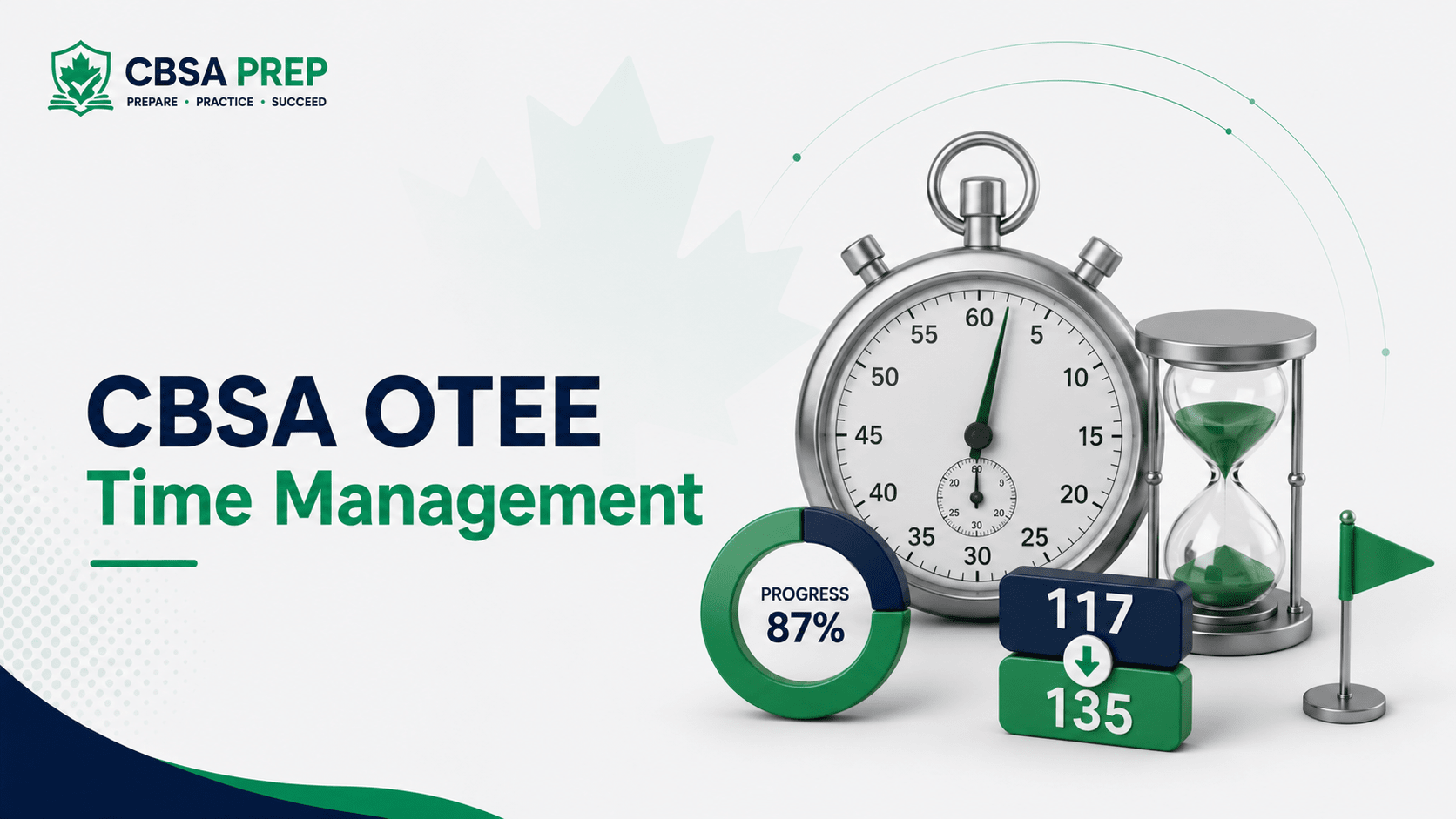
The 117-question, 135-minute format gives you about 69 seconds per question. That number is useful, but it should not be treated as a strict rule for every item.
Some questions may be shorter and more direct. Others may require more careful reading, comparison, or judgement. A candidate who spends the same amount of time on every question may move too slowly on simple items and too quickly on complex ones.
The goal is not to count exactly 69 seconds each time. The goal is to build a practical pacing sense: move efficiently through questions you can answer confidently, and protect enough time for questions that require deeper thought.
Why CBSA OTEE Time Management Matters
CBSA OTEE time management matters because the exam assesses more than whether you can eventually find an answer. It also tests whether you can work carefully under time pressure.
Poor timing can cause several problems:
- rushing through questions you understand
- spending too long on one difficult item
- losing focus in the second half of the exam
- leaving too little time for longer scenarios
- making careless errors because of pressure
- failing to review your choices carefully where time allows
For many candidates, the challenge is not only knowing what to do. It is doing it consistently for 135 minutes.
How Timing Connects to the Four OTEE Competencies
The CBSA does not publicly disclose the exact number of questions assigned to each competency. However, the official exam assesses four competency areas, and each can place different demands on your time.
Reasoning Skills: Work Methodically
Reasoning skills questions require you to draw conclusions, identify relationships, or use information to solve problems.
These questions often reward a methodical approach. Rushing can lead to avoidable mistakes, especially when the question includes small details. At the same time, reasoning questions should not become a place where you repeatedly second-guess yourself.
A good timing approach is to read carefully, apply a clear method, answer, and move on. If you are genuinely stuck after a reasonable effort, make your best supported choice and continue rather than allowing one question to consume excessive time.
Analytical Thinking: Read Before You Answer
Analytical thinking questions may require more careful reading because they involve breaking down a situation or problem to reach an outcome.
The timing risk here is trying to answer before you fully understand the setup. Skimming may feel faster, but it can lead to re-reading and correction later.
For analytical thinking, it is often better to invest time upfront in understanding the situation, then answer with more confidence. This protects accuracy and reduces the chance of losing time through repeated re-reading.
Client Service Orientation: Avoid Overthinking
Client service orientation assesses the ability to provide quality, timely, complete, courteous, fair, and appropriate service to internal and external clients.
These questions often require judgement. The challenge is that more than one option may look partly reasonable. Candidates can lose time by repeatedly comparing options without making a decision.
Your goal is to identify the response that best reflects professional service, fairness, completeness, and sound judgement. Read the scenario carefully, compare the options, choose the strongest answer, and keep moving.
Writing Skills: Use Strengths Carefully
Writing skills questions assess clarity, grammar, sentence structure, vocabulary, and professional communication.
For candidates with strong grammar and vocabulary, some writing skills questions may be faster than scenario-heavy items. That can create a useful time buffer. For candidates who find writing skills harder, this area needs targeted practice before the official exam.
Do not assume writing questions will always be easy. Practise them under time pressure so you know whether they are a strength or a risk area for your own preparation.
The One-Sitting Rule and Exam Stamina
The official CBSA page states that candidates have one week to complete the test, but once the test is started, it must be finished. That makes stamina part of CBSA OTEE time management.
A candidate may perform well on short practice sets but struggle during a full 135-minute session. Focus can decline as the exam continues, especially if you are reading carefully and making judgement-based decisions.
This is why full-length timed practice matters. It trains more than question knowledge. It trains concentration, pacing, and decision quality over the full exam period.
For deeper preparation, CBSA OTEE Practice Exams can help candidates practise in a timed format before the official exam.
A Practical CBSA OTEE Pacing Strategy
A strong pacing strategy does not require checking the clock after every question. It requires clear habits.
Start Carefully
Use the opening questions to settle into the exam. Do not rush just because the timer has started. Early careless mistakes count the same as later mistakes.
Read the question fully, understand what is being asked, and answer with focus.
Move With Purpose
There is a difference between moving quickly and moving with purpose.
Moving quickly often means skimming, guessing too early, or ignoring details. Moving with purpose means reading efficiently, applying your reasoning, choosing the best answer, and advancing without unnecessary delay.
The second approach is more useful for the OTEE.
Do Not Let One Question Control the Exam
If a question is blocking you after a reasonable effort, move on. Spending several minutes on one item can reduce your ability to answer later questions properly.
This does not mean careless guessing. It means recognizing when the time cost of one question is becoming too high.
Check Your Progress During the Exam
You do not need to calculate every second. However, you should be aware of your overall pace.
A simple habit is to check your position at a few broad points during the exam. For example, notice whether you are roughly on track halfway through the time. If you are behind, increase your pace on question types where you tend to overthink.
Use the Final Minutes Wisely
If time is running low, focus on completing remaining questions as carefully as possible. Do not spend the final minutes stuck on one difficult item while several questions remain unanswered.
The safest approach is to give each remaining question your best available answer within the time left.
Time Management Mistakes That Cost Candidates Marks
Mistake 1: Practising Only Untimed Questions
Untimed practice can help you learn question types, but it does not show whether you can perform under exam pressure.
Once you understand the basics, timed practice should become part of your preparation.
Mistake 2: Treating Every Question the Same
Some questions require more reading and judgement than others. Using the same pace for every item can create problems.
A better approach is to vary your pace based on question complexity while still protecting overall completion.
Mistake 3: Re-Reading Too Much
Some re-reading is normal. But if you read the same question several times because you are unsure, you may be losing time to hesitation.
Read carefully once, check the key details, choose the best answer, and move forward unless there is a clear reason to return.
Mistake 4: Ignoring Weak Competencies
If analytical thinking or writing skills slows you down, general practice may not fix the problem. You need targeted work on the competency that is costing you time.
Good CBSA OTEE time management starts before exam day by identifying where your pace breaks down.
Mistake 5: Avoiding Full-Length Practice
Short sets are useful, but they cannot fully prepare you for 117 questions in one sitting.
Full-length timed practice helps you understand how your focus, pacing, and accuracy change over the full exam period.
How to Build OTEE Timing Discipline in Practice
Effective timing preparation should happen in stages.
Stage 1: Learn the Question Types Without a Timer
Start by understanding the four competency areas. Practise slowly enough to learn what each question is asking.
Speed is not useful if your method is inaccurate.
Stage 2: Add Timed Practice by Competency
Once you understand the question types, practise timed sets by competency.
This helps you see whether reasoning skills, analytical thinking, client service orientation, or writing skills is slowing you down most.
Stage 3: Use Mixed Timed Sets
The official exam requires candidates to shift between different types of thinking. Mixed timed sets help you practise that transition.
They also reduce the risk of becoming comfortable with only one question type.
Stage 4: Complete Full-Length Timed Simulations
If possible, complete one or more full-length timed practice exams before the official OTEE. Use one sitting, no pausing, and a 135-minute time limit.
After each attempt, review incorrect and guessed answers. Look for patterns:
- Which competency took the most time?
- Where did your accuracy drop?
- Did you rush near the end?
- Did you lose time re-reading?
- Did you finish with time left but make careless errors?
This review is where timing improves.
For structured practice, timed CBSA OTEE practice exams can help you move from short practice sets to full exam-style simulation.
How the 60% Competency Threshold Affects Time Management
CBSA public Q&A material has referenced that candidates must achieve 60% correct in each competency area to be successful. Because this information may appear outside the main entrance exam page, candidates should treat it as an important public reference and continue checking official CBSA recruitment materials for the most current exam requirements.
This matters for timing because you should not sacrifice one competency to save time for another. If you rush through analytical thinking or writing skills and accuracy drops too far, finishing the exam quickly will not help.
The practical lesson is simple: time management must protect both completion and accuracy across all four competency areas.
How CBSA PREP Supports Time Management Practice
CBSA PREP is an independent OTEE preparation platform designed to help candidates practise exam-style questions under timed conditions.
CBSA PREP includes:
- 6 timed CBSA OTEE practice exams
- 800+ competency-mapped practice questions
- full answer explanations
- smart retake options
- $69 one-time payment
- lifetime access with no monthly subscription
This helps candidates move from basic question familiarity to structured timed practice, weak-area review, and full exam-style preparation.
Key Takeaways
- CBSA OTEE time management is essential because the exam has 117 questions and a 135-minute limit.
- The 69-second average is useful, but not every question should receive the same amount of time.
- Different competencies can create different timing challenges.
- Full-length timed practice helps build stamina for the one-sitting exam format.
- Strong pacing protects both completion and accuracy.
- Avoid unsupported shortcuts, leaked-question claims, and last-minute cramming.
- Use timed practice to identify weak competencies before the official exam.
Frequently Asked Questions
How much time do I have per question on the CBSA OTEE?
The average is about 69 seconds per question because the exam has 117 questions and 135 minutes. In practice, some questions may take less time and others may require more careful reading.
Is 135 minutes enough time to finish the CBSA OTEE?
It can be manageable for candidates who practise under timed conditions. Candidates who only practise untimed questions may find the full 135-minute exam more difficult because of pacing and stamina.
What is the best CBSA OTEE time management strategy?
The best strategy is to practise by competency, then use mixed timed sets, then complete full-length timed simulations. During the exam, move with purpose, avoid overthinking, and do not let one difficult question consume too much time.
Can I go back and change answers on the CBSA OTEE?
The public CBSA entrance exam page does not describe the exam interface in enough detail to rely on this as a strategy. Prepare to give each question your best answer the first time. If review is available, treat it as a bonus.
Does the CBSA OTEE show a timer during the exam?
The official CBSA entrance exam page does not provide detailed interface information about timer display. Practise with a timer so your pacing does not depend entirely on interface features.
How does the 60% competency threshold affect time management?
CBSA public Q&A material has referenced 60% correct in each competency. This means candidates should protect accuracy across all four areas, not simply rush to finish the exam.
How many timed practice exams should I take before the CBSA OTEE?
There is no official required number. If possible, complete one or more full-length timed simulations so you can test pacing, stamina, and accuracy under exam-like conditions.
What should I do if I am running out of time?
Stay calm and focus on giving remaining questions your best available answers within the time left. Avoid spending the final minutes stuck on one difficult question while several questions remain unanswered.